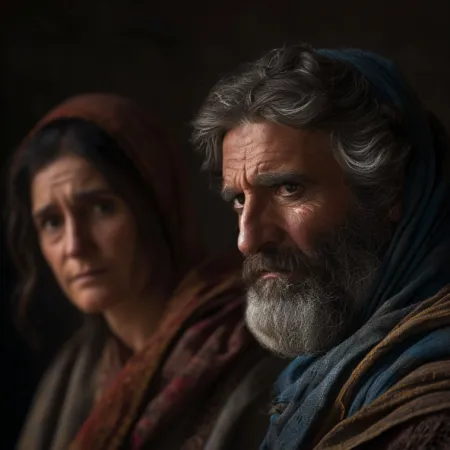
Jesus teaches about humility and the Parable of the Pharisee and the Tax Collector.
1And he spake a parable unto them to this end, that men ought always to pray, and not to faint;
2Saying, There was in a city a judge, which feared not God, neither regarded man:
Luke 18:3 - And there was a widow in that city; and she came unto him, saying, Avenge me of mine adversary.
3And there was a widow in that city; and she came unto him, saying, Avenge me of mine adversary.
4And he would not for a while: but afterward he said within himself, Though I fear not God, nor regard man;
5Yet because this widow troubleth me, I will avenge her, lest by her continual coming she weary me.
6And the Lord said, Hear what the unjust judge saith.
7And shall not God avenge his own elect, which cry day and night unto him, though he bear long with them?
8I tell you that he will avenge them speedily. Nevertheless when the Son of man cometh, shall he find faith on the earth?
9And he spake this parable unto certain which trusted in themselves that they were righteous, and despised others:
10Two men went up into the temple to pray; the one a Pharisee, and the other a publican.
11The Pharisee stood and prayed thus with himself, God, I thank thee, that I am not as other men are, extortioners, unjust, adulterers, or even as this publican.
12I fast twice in the week, I give tithes of all that I possess.
13And the publican, standing afar off, would not lift up so much as his eyes unto heaven, but smote upon his breast, saying, God be merciful to me a sinner.
14I tell you, this man went down to his house justified rather than the other: for every one that exalteth himself shall be abased; and he that humbleth himself shall be exalted.
15And they brought unto him also infants, that he would touch them: but when his disciples saw it, they rebuked them.
16But Jesus called them unto him, and said, Suffer little children to come unto me, and forbid them not: for of such is the kingdom of God.
17Verily I say unto you, Whosoever shall not receive the kingdom of God as a little child shall in no wise enter therein.
18And a certain ruler asked him, saying, Good Master, what shall I do to inherit eternal life?
19And Jesus said unto him, Why callest thou me good? none is good, save one, that is, God.
20Thou knowest the commandments, Do not commit adultery, Do not kill, Do not steal, Do not bear false witness, Honour thy father and thy mother.
21And he said, All these have I kept from my youth up.
22Now when Jesus heard these things, he said unto him, Yet lackest thou one thing: sell all that thou hast, and distribute unto the poor, and thou shalt have treasure in heaven: and come, follow me.
23And when he heard this, he was very sorrowful: for he was very rich.
24And when Jesus saw that he was very sorrowful, he said, How hardly shall they that have riches enter into the kingdom of God!
25For it is easier for a camel to go through a needle's eye, than for a rich man to enter into the kingdom of God.
26And they that heard it said, Who then can be saved?
27And he said, The things which are impossible with men are possible with God.
28Then Peter said, Lo, we have left all, and followed thee.
29And he said unto them, Verily I say unto you, There is no man that hath left house, or parents, or brethren, or wife, or children, for the kingdom of God's sake,
30Who shall not receive manifold more in this present time, and in the world to come life everlasting.
31Then he took unto him the twelve, and said unto them, Behold, we go up to Jerusalem, and all things that are written by the prophets concerning the Son of man shall be accomplished.
32For he shall be delivered unto the Gentiles, and shall be mocked, and spitefully entreated, and spitted on:
33And they shall scourge him, and put him to death: and the third day he shall rise again.
34And they understood none of these things: and this saying was hid from them, neither knew they the things which were spoken.
35And it came to pass, that as he was come nigh unto Jericho, a certain blind man sat by the way side begging:
36And hearing the multitude pass by, he asked what it meant.
37And they told him, that Jesus of Nazareth passeth by.
38And he cried, saying, Jesus, thou Son of David, have mercy on me.
39And they which went before rebuked him, that he should hold his peace: but he cried so much the more, Thou Son of David, have mercy on me.
40And Jesus stood, and commanded him to be brought unto him: and when he was come near, he asked him,
41Saying, What wilt thou that I shall do unto thee? And he said, Lord, that I may receive my sight.
42And Jesus said unto him, Receive thy sight: thy faith hath saved thee.
43And immediately he received his sight, and followed him, glorifying God: and all the people, when they saw it, gave praise unto God.